How to become a Great Writer!
May 24, 2016 at 12:02 pm | Posted in children's literacy, Writing competitions for kids | 3 CommentsTags: Clever Competition, Jemma Julian
As an author of children’s books, perhaps one of the most frequent questions I get asked by kids is “How do I become a great writer?”. Now anyone who knows me will know what my answer will be: “You have to read LOTS and LOTS and LOTS of books!”
But I thought it would be interesting to find out from kids your age, who are already great writers, just how they’ve done it themselves!
In this post, I’d like to introduce you to Jemma Julian, from Sydney in Australia, who regularly wins a place in the top ten in my Clever Competitions! Her writing is wonderful, full of original ideas, fantastic words and great imagination, and I encourage you to look at the results of my Clever Competitions over the last three years (see tabs on the right hand column) to see examples of her work!

Here you can see Jemma posing with her signed copy of my Dark Horse Activity Book which she won when she came first in my Ode to my Favourite Tree Competition in 2014, when she was just 9 years old.
I wrote to Jemma last week to ask her some questions about what she does in her spare time, and I thought you’d be very interested to read her answers! Here, with Jemma’s permission, is what she told me, and I think it’s worth reading EVERY WORD of what she says :). I’ve highlighted in bold the bits I think are most important:
“In answer to your questions:
I write my current stories almost every few days, often on the weekends as I don’t always get enough time during the week. For just general writing, I mostly just to write back to emails and letters from my penpals and aunt, who I correspond with regularly.
I mostly just write on the computer, as I find that typing is easier to read for me. I make my writing neat for letters to people, so that they can easily read them, but when writing stories I often have heaps of new ideas, thus my writing gets spikier, my letters not fully- formed, which makes it harder to read…
Yes, I keep a diary, and also a scrapbook diary, where I stick and paste things cut out of magazines, newspapers, or drawings I’ve done.
I suppose I have a writer’s notebook. I’ve actually never heard the term before, but I have a notebook which I’ve had since I was eight in which I’ve written stories, looked up words, written sentences for words, poems, written answers to questions for schoolbooks which don’t give space for answers and various other things I’ve done.
My other hobbies apart from writing stories are writing songs, (only just today I wrote music to a song I’ve written- the first time ever!), writing poems,writing letters, feeding the many birds which come to eat sunflower seeds in the backyard, playing the piano, drawing, dancing, swimming, reading as many books as I can, typography, calligraphy, ornithology, and climbing trees.
Here are my tips for other children to improve their writing:
- To write something everyday– it doesn’t even have to be a story! It could be an essay for school, a project about something you’re interested in, an email to a friend, even a letter to a relative long overdue!
- To read whenever you can! I love reading, and even read at lunchtime, despite my parents’ not liking it! Books can give you the foundations for your own stories, ideas to weave into your stories, fantastically interesting words to use, (I need to thank you, Sarah, your word ‘splendiferous’ features regularly in letters, and I use ‘idiosyncrasies’ occasionally during speech), and much, much, much more.
- To edit, revise, and rewrite your stories again and again and again. Editing can be a bore, especially when you’ve put your heart and soul into a scene but then find it doesn’t work with the rest of the story, but still essential. Revising too, but still, finding a word miss spelled and correcting it makes me feel like I’ve saved the story from badly written words. Rewriting is fun! I love looking back into a story I wrote a while ago and thinking about all the things I’d like to change about it.
- To ask for feedback. Writing a story on your own can be a bit monotonous as you can’t get other people’s views on your stories! You don’t have to ask only other writers for feedback- you could ask your parents, (if they’re not too busy), your friends, your school teachers, the kids in your class at school.
- To always jot ideas down, however silly you think they are. Some of the stories I consider masterpieces began from some crazy idea I had a year ago, which I wrote down in a notebook, to be discovered later and turned into a story.
- I also think that grammar is important too! A grammatically imperfect story isn’t always a good one. Read through your stories every once in a while to check them, and also experiment with little letters, colons, or even the odd bracket. I’ve found that just adding a comma in some cases fixes up a whole sentence!
The answer to your question of ‘how much time do you spend reading books for leisure’ is WHENEVER POSSIBLE! As I said before, I read even at lunch!
I don’t play any computer games, though I used to once a week for an hour… Our television isn’t wired up to any stations, so I don’t watch it. Occasionally I will watch a movie with my family. I do use some social media. Since the national postage rate went up to a dollar- the slowest postage- I have mostly been emailing my penpals. I do also have Google+, but I mostly don’t really have any time to post things on it. All in all I mostly spend, (excluding writing stories), up to half an hour on the computer a day. I don’t often get emails though, normally about one or two a week, so that makes the time I spend on the computer shorter. When I’m writing a story, the time spent on the computer gets larger, up to about two hours. I normally don’t just write though- I look up words I think could be used in my story, I research things to do with my story and check my emails.”
Soooooo….in a nutshell, the way Jemma has become a Great Writer is by:
- writing something every day
- having penpals
- reading as many books as she can get her hands on
- limiting the time she spends on digital screens to half an hour a day, except when she is writing a story, when she might spend up to 2 hours a day doing research, using her computer as a TOOL but not a toy
- keeping a diary
- keeping a writer’s notebook to jot down ideas for stories, special words etc
- enjoying lots of different hobbies outside and inside the house
- editing and revising her stories over and over again
- practising her grammar!
So now you’re heard it from an expert who is still just 11 years old! If you can follow her advice, your writing is just going to get better and better! Thanks Jemma for all the fabulous tips! One day, I just know that we’re going to see your name up in lights!
Imagine if your library looked like this…
May 3, 2016 at 2:59 pm | Posted in children's literacy | Leave a commentTags: Room to Read

Just take a look at this photo! This is an actual photo of a REAL school library in a village in Nepal, taken by Geordie Torr, Editor of National Geographic Australia and New Zealand, just last week! Geordie has very kindly given me permission to re-post this photo from his fantastic travel blog.
Can you imagine how sad you would be if this was YOUR library? The books are old and scruffy, piled up in a higgledy heap, and most of them are random donations from passing travellers, so they’re of little interest to children. And there are hardly any books at all! How would you ever fall in love with reading books if this was your only access to them?
But thousands of kids your age have school libraries like this – or sometimes no library at all – in places like Nepal, and in many countries in Asia and Africa and the developing world. That’s why it’s so important for all of us, who were lucky enough to be born in rich countries, to support charities like Room To Read, which is having an amazing impact on schools just like this. Make sure you show Mum and Dad this page – your teachers too – and see what you can do to help these children.
Here’s a link to get you started: http://www.roomtoread.org.
And when you’ve done that, take a look at Geordie’s fabulous blog at http://natgeotraveller.com.au/blog!
The Judging Begins!
April 12, 2016 at 9:41 am | Posted in children's literacy, Writing competitions for kids | Leave a commentTags: Clever Competition, Year of the Monkey

Well done to all those clever writers who got their entries in to my Mischievous Monkey Story Writing Competition by the extended deadline date on Sunday! I’m starting the judging right now, and will post the results as soon as I can! Hang in there!
Little Star Magazine’s writing competition awards in Shanghai!
April 12, 2016 at 9:35 am | Posted in Being an Author, children's literacy, workshops, Writing competitions for kids | Leave a commentTags: Little Star Magazine, The Tale of Ming Kee Monkey, YCIS
No sooner that I was back from Bologna, than I was on a plane to Shanghai, to attend the Awards Ceremony on Saturday in the Little Star Writing Competition for over 500 kids in Beijing and Shanghai schools! As the final judge, I was there to officiate at the Awards Ceremony hosted by Yew Chung International School’s Gubei campus, and to talk to the exceptional writers who won First Place in each of the four age categories. We even fitted in time for a story reading of my latest Chinese Calendar Tale for the kids, mums and dads, and a Writing Workshop for everybody at the end! Many thanks to Little Star Magazine, YCIS and the fabulous kids and parents who gave me such a warm welcome. And huge congratulations to all the talented finalists!


A fun interview with Noreen Mir at RTHK3!
March 12, 2016 at 1:58 pm | Posted in Books about Chinese Zodiac, children's literacy, Chinese New Year, Press | Leave a commentTags: Chinese Calendar Tales, RTHK3, The Tale of Ming Kee Monkey, Year of the Monkey
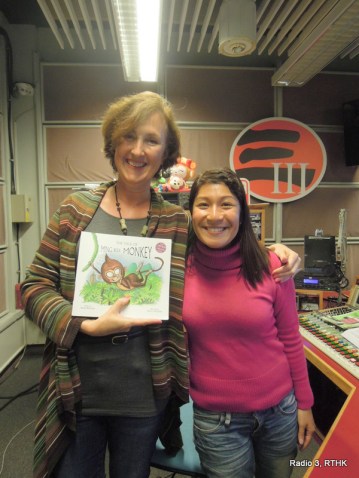
On Thursday I had a fabulous interview with Noreen Mir at RTHK3 in Kowloon Tong. If you want to hear us talk about The Tale of Ming Kee Monkey, the fantastic history behind it, as well as all my other books about the Chinese Zodiac AND how to become great readers and writers in the digital age, here is the link!

Blog at WordPress.com.
Entries and comments feeds.
 Sarah Brennan Funny & Fabulous Blog